Artificial intelligence isn't a future concept in manufacturing anymore - it's the foundation modern industrial operations are being built on.
Factories worldwide are adopting AI-powered technologies to drive productivity, cut operational costs, tighten quality control, and accelerate automation. As Industry 4.0 continues to mature, the gap between early adopters and everyone else is widening fast.
Here's a look at how AI is reshaping manufacturing, where it's being applied, and what that means for businesses planning their next move.
What Is AI in Manufacturing?
AI in manufacturing means using intelligent software, machine learning algorithms, robotics, computer vision, and data analytics to automate and optimize production operations, with minimal human intervention.
Modern AI-powered environments pull from several converging technologies: machine learning, industrial automation and robotics, IoT-enabled smart systems, predictive analytics, computer vision, and real-time production analytics. Together, these create systems capable of self-monitoring, predictive maintenance, automated quality inspection, and continuous production optimization.
How It Works on the Floor
AI systems depend on real-time data. IoT sensors, connected machines, and cloud platforms feed operational data from production lines into AI algorithms that identify inefficiencies, predict failures, and optimize workflows before problems occur.
A machine showing abnormal vibration patterns or temperature drift? AI catches it before it becomes downtime. A component outside dimensional tolerance? A vision system flags it automatically - faster and more consistently than any manual inspection process.
Why Manufacturers Are Moving Now
Rising competition, labor shortages, and tighter quality requirements are pushing manufacturers to act. AI addresses all three simultaneously
- Increasing Production Efficiency: AI reduces bottlenecks, optimizes workflows, and enables real-time adjustments that keep lines moving.
- Reducing Operational Costs: Predictive maintenance alone can dramatically reduce unplanned downtime and repair expenses. Add optimized energy use and reduced material waste and the savings compound quickly.
- Improving Quality Consistency: Computer vision and machine learning maintain inspection standards at a level human operators can't sustain across high-volume production.
- Faster Decisions: Real-time analytics give supervisors and engineers the data they need to act, not react.
Key Applications of AI in Manufacturing
- Predictive Maintenance: AI monitors machine health continuously. When anomalies are detected, it predicts failures before they happen - shifting manufacturers from reactive repair cycles to scheduled, proactive maintenance. The result: reduced downtime, lower repair costs, and improved equipment lifespan.
- Smart Factory Automation: Smart factories integrate robotics, IoT, cloud platforms, and intelligent software into connected production ecosystems. The result: automated lines, remote monitoring, and data-driven decisions at every stage.
- AI-Powered Quality Control and Traceability: Traditional inspection is slow and inconsistent. AI-driven computer vision analyzes images and production data to catch surface defects, dimensional errors, and assembly issues in real time, at speeds and accuracy levels manual inspection can't match.
But quality control doesn't stop at the inspection station. Full traceability - knowing exactly what was made, when, to what standard, and through which process - is what separates reactive quality management from proactive manufacturing intelligence. Platforms like Arcstone MES connect shop floor data across the entire production chain, enabling end-to-end traceability: every component tracked from raw material through finished goods, with inspection data, process parameters, and timestamps to back it up. When a customer or regulator asks for documentation, the answer is a report - not a search through paper records.
- Industrial Robotics and Cobots:Modern robotic systems handle welding, material handling, machine tending, packaging, and assembly with precision and consistency. Collaborative robots (cobots) work alongside operators, improving throughput without compromising safety. In high-mix, low-volume environments especially, cobots with integrated vision are closing the gap between flexible manual work and the repeatability of hard automation.
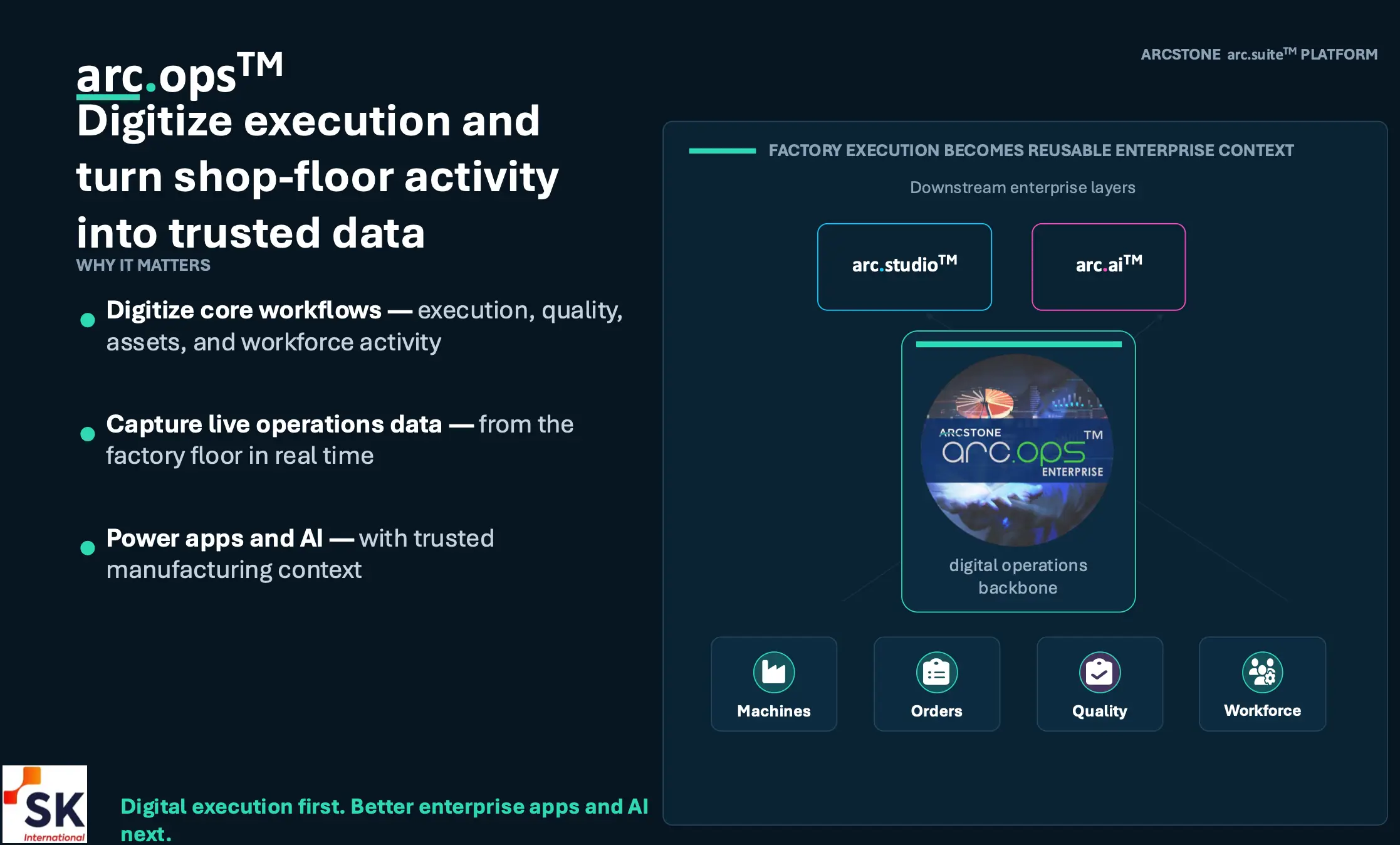
- MES and Shop Floor Intelligence: AI is only as useful as the data infrastructure supporting it. Manufacturing Execution Systems (MES) create the connected data layer that makes AI actionable - linking machines, operators, work orders, and quality records into a single real-time view of the operation. The result is visibility that goes beyond dashboards: manufacturers can trace defects back to their source, identify process drift before it becomes a quality event, and maintain the documentation required for regulated industries and demanding customers.
- Supply Chain Optimization: AI forecasts demand, optimizes inventory, and improves logistics planning, reducing disruptions before they hit the production schedule.
- Digital Twin Technology: Virtual models of production environments allow manufacturers to simulate changes, monitor equipment performance, and optimize workflows before committing to real-world implementation.
AI and Industry 4.0
AI is the engine behind Industry 4.0. IoT devices collect the data; AI systems act on it. Cloud platforms centralize management and scale operations. Connected factories improve communication across machines, operators, and systems - creating environments that are genuinely responsive rather than just monitored.
Implementation Challenges Worth Knowing
AI adoption isn't without friction. Initial investments in hardware, software, and training are real. Cybersecurity risks increase with connected systems. Older infrastructure doesn't always integrate cleanly with modern AI platforms. And the value of AI is only as good as the quality of data feeding it.
These aren't reasons to wait - they're reasons to choose the right implementation partner.
What's Coming
Autonomous factories. Generative AI supporting design and process optimization. AI-driven supply chains that anticipate disruption rather than respond to it. Continued growth in human-robot collaboration. And a sharper focus on sustainability - using AI to reduce waste, optimize energy, and improve resource efficiency across the production cycle.
AI in Action: How SK International Is Deploying It
Understanding AI in manufacturing is one thing. Deploying it effectively is another. Here are three ways SK International is putting these technologies to work on production floors today.
-
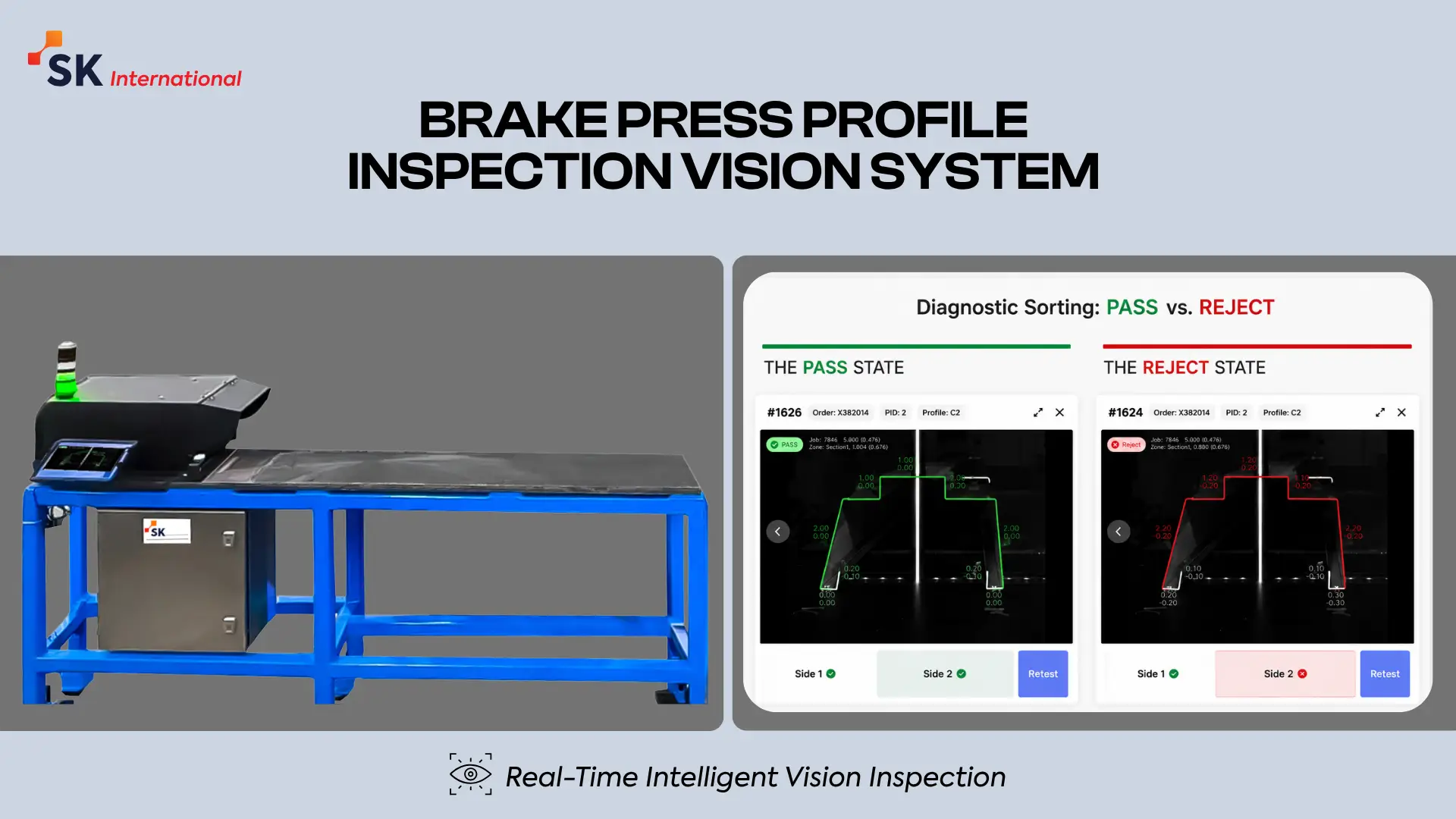
Brake Press Profile Inspection Vision System: SK International deployed an advanced vision inspection system combining calibrated imaging hardware, controlled illumination, and deterministic dimensional-analysis algorithms to achieve ±0.03 in. measurement accuracy. The system delivers immediate pass/fail feedback through an integrated GUI, allowing customers to isolate non-conforming components in real time and use the resulting inspection data to drive targeted process improvements and measurable reductions in defect rates. Real-time inspection. No guesswork. No paper trails.
-
Vision-Guided Cobot Laser Welding: High-mix, low-volume manufacturing has always been the hardest environment to automate - part runs are short, parts change constantly, and traditional welding cells weren't built for it. The SK Robotics Cobot Laser Weld Cell was. Built in partnership with Syntec and brought to North America by SK Robotics, the cell uses vision-guided positioning and native real-time seam tracking to eliminate the manual overhead that quietly destroys ROI in job shop environments. One-button vision positioning locks onto the exact weld target automatically. Part variation up to 5mm is compensated in real time — no line scanner bolted on, no high-precision fixturing required. For contract manufacturers, Tier 2 and Tier 3 automotive suppliers, EV assemblers, and aerospace fabricators running dozens of part numbers in a single shift, it's the flexibility of manual work with the repeatability of hard automation. Read the full breakdown on SK Robotics →
-
MES and Grade-A Traceability with Arcstone: SK International is the North American showcase partner for Arcstone, a next-generation MES platform. Arcstone's arc.ops platform connects machines, work orders, quality records, and personnel data into a single real-time view of the operation, giving manufacturers the shop floor intelligence to make AI meaningful. Every input tracked. Every process step timestamped. Every quality decision documented and retrievable. For manufacturers operating in regulated industries or under demanding customer requirements, Arcstone turns traceability from a compliance burden into a competitive capability. As Arcstone's North American showcase, SK International deploys and supports arc.ops across manufacturing environments of every size - from SMEs taking their first steps toward digitalization to enterprise operations scaling across multiple facilities.
Ready to Modernize Your Manufacturing Operations?
SK International works with manufacturers across industries to deploy intelligent automation solutions - from robotics integration and computer vision to MES implementation and full smart manufacturing systems. If you're evaluating where AI fits in your operation, Contact Us.
Frequently Asked Questions
- What is AI in manufacturing? The application of machine learning, robotics, computer vision, and intelligent automation to improve production efficiency and operational performance.
- How does AI improve manufacturing efficiency? By automating repetitive tasks, optimizing workflows, reducing unplanned downtime, and enabling predictive — rather than reactive — maintenance.
- What are smart factories? Connected manufacturing environments where AI, IoT, automation, and analytics work together to improve production at every stage.
- What is an MES and why does it matter for AI? A Manufacturing Execution System (MES) is the data layer that makes AI actionable on the shop floor — connecting machines, work orders, quality records, and personnel into a real-time operational picture. Without it, AI has nothing reliable to act on.
- How is machine learning used in manufacturing? Predictive maintenance, quality inspection, supply chain forecasting, and process optimization are the most common applications.
- Is AI replacing workers in manufacturing? Primarily, no. AI automates repetitive and hazardous tasks, freeing workers to focus on higher-value responsibilities. The bigger workforce shift is toward roles requiring AI and automation expertise.